The Module: Verilog's Building Block
Every Verilog design is composed of modules.
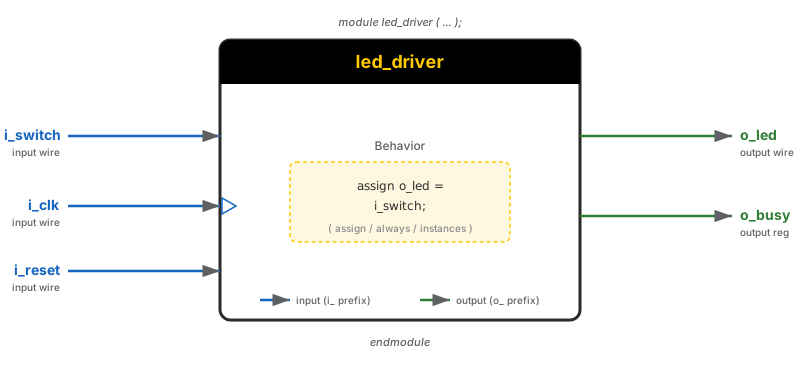
⚠️ If You're Thinking Like a Programmer…
❌ Wrong Model
“input and output are like function parameters.
Data ‘flows in’ through input ports when I
‘call’ the module.”
✓ Right Model
Module ports are physical pins on a chip-shaped
abstraction. input ports are pins pulled by external wires;
output ports are pins driven by internal logic. There's no
“call” — the module is always active, like a DIP package soldered
onto a board.
output port. Multi-output modules
are the norm, not the exception.
The Module Template
module led_driver (
    input  wire i_switch,
    output wire o_led
);

    assign o_led = i_switch;

endmodule
① module keyword + name
② Input ports — signals coming in
③ Output ports — signals going out
④ Semicolon after closing paren — don't forget this!
⑤ Behavior — assign, always, or sub-module instances
⑥ endmodule — no semicolon here
Port Style: ANSI (Modern) vs. Non-ANSI
✓ ANSI Style (use this)
module adder (
    input  wire [3:0] i_a,
    input  wire [3:0] i_b,
    output wire [4:0] o_sum
);
    assign o_sum = i_a + i_b;
endmodule
✗ Non-ANSI (legacy)
module adder (i_a, i_b, o_sum);
    input  [3:0] i_a;
    input  [3:0] i_b;
    output [4:0] o_sum;

    assign o_sum = i_a + i_b;
endmoduleNaming Conventions
module my_design (
    input  wire       i_clk,        // i_ = input
    input  wire       i_reset,
    input  wire [7:0] i_data,
    output wire       o_valid,       // o_ = output
    output reg  [7:0] o_result
);
    wire [7:0] w_intermediate;       // w_ = internal wire
    reg  [3:0] r_counter;            // r_ = register (sequential)
// ...| Prefix | Meaning | Example |
|---|---|---|
i_ | Input port | i_switch |
o_ | Output port | o_led |
w_ | Internal wire | w_sum |
r_ | Register (assigned in always) | r_count |
Build a Module from Scratch
Starting from an empty file → day01_ex01_led_driver.v
module → ports → assign → endmodule
Common Error #1: The Missing Semicolon
module my_module (
    input  wire a,
    output wire y
)                         // ← MISSING SEMICOLON
    assign y = a;
endmodule
module my_module (
input wire a,
output wire y
); // ← CORRECT
assign y = a;
endmoduleYou will make this mistake. The error message won't point to the right line. Now you know what to look for.
Common Error #2: Mismatched Widths
module oops (
    input  wire [7:0] i_data,    // 8 bits
    output wire [3:0] o_result   // 4 bits
);
    assign o_result = i_data;    // ← truncation! upper 4 bits lost
endmoduleday01_ex02_button_logic.v
Multiple gates — concurrent assign statements
Direct → NOT → AND → XOR · all operating simultaneously
🤖 Check the Machine
Ask an AI assistant:
“What happens if I declare a signal as output reg but
then drive it with an assign statement outside the module?”
TASK
Ask about mixing output reg with external assign.
BEFORE
Predict: “Compile error”? “Silent bug”? What's the failure mode?
AFTER
Correct answer: external assign to an output reg is a Verilog error. iverilog catches this.
TAKEAWAY
Compile first, trust the compiler second, verify third. Use iverilog -Wall always.
Key Takeaways
① Modules are the fundamental building block — inputs, outputs, behavior.
②
assign = permanent wire, not a one-time computation.
③
Use ANSI-style ports and consistent naming (i_, o_, r_, w_).
④
Don't forget the semicolon after ); in the port list.
🔗 Transfer
Digital Logic Refresher
Day 1, Video 4 of 4 · ~8 minutes
▸ WHY THIS MATTERS NEXT
You now have the module skeleton. Video 4 reminds you what goes inside — the combinational gates (AND, OR, XOR, MUX) you'll combine to build every combinational circuit in this course. If this material feels dusty from a prior class, that's fine: think of it as calibrating the vocabulary we'll use for Weeks 1 and 2.